
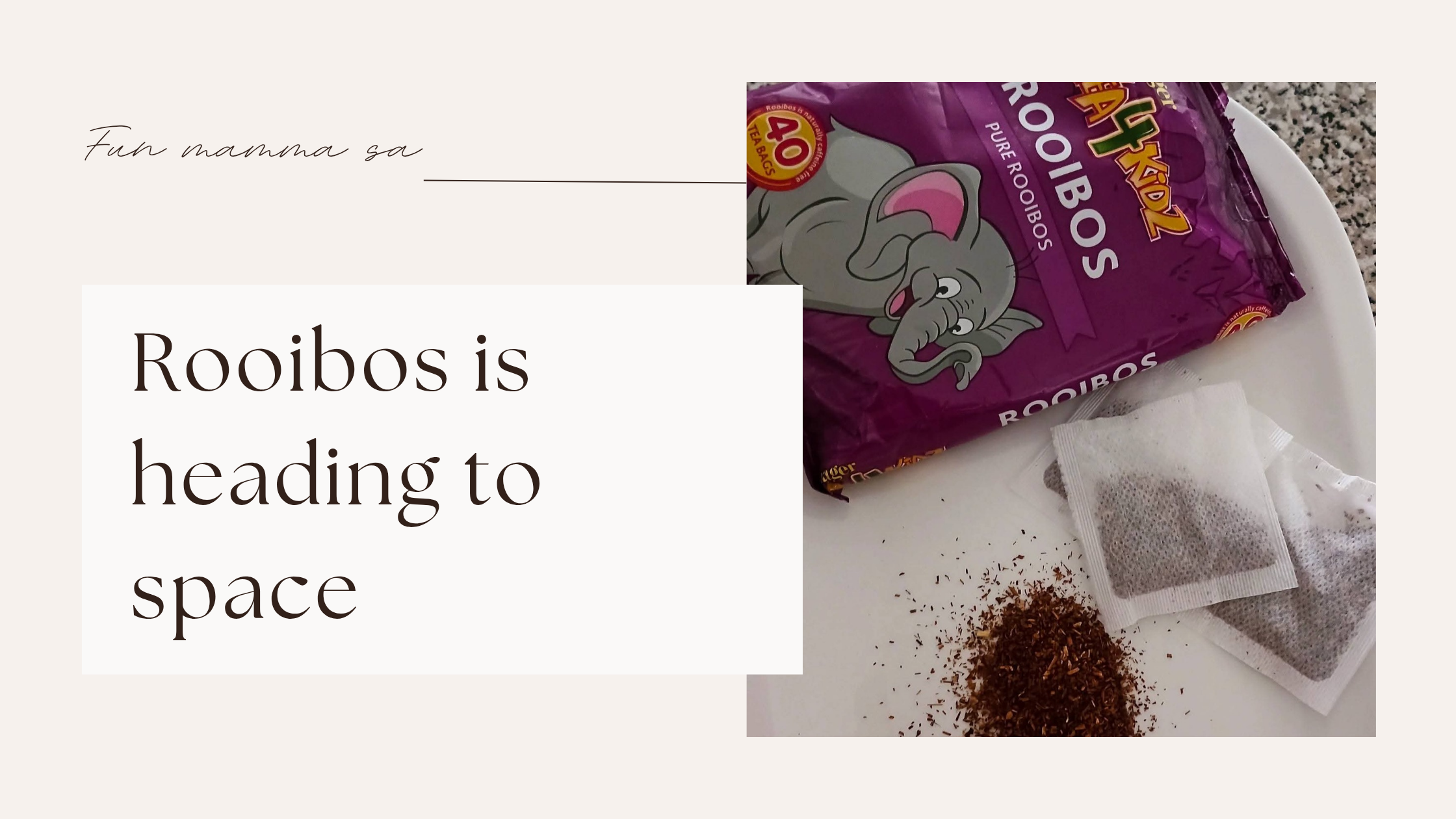
Rooibos seeds are heading to space

Rooibos seeds are being sent into space this October as a current experiment and we set some time aside today to learn more about this fascinating plant.
About Rooibos plants
Rooibos, translated as Red Bush, is a unique herbal tea made from a plant native to the Cederberg region of South Africa. It is entirely caffeine-free, low in tannins, and packed with healthy antioxidants.
The plant, Aspalathus linearis, is a broom-like shrub with soft, needle-like leaves.

History of Rooibos in south Africa
The Rooibos history in South Africa, began with the indigenous Khoisan people more than 300 years ago.
It was documentation by Carl Thunberg, and commercialization by Benjamin Ginsberg.
Today, Rooibos is well known and widely sold around the world.

Benefits of Rooibos tea
There are many health benefits to drinking rooibos tea.
Caffeine-Free: Rooibos is safe for people of all ages and won’t disrupt sleep.
Low Tannins: It allows better iron absorption compared to black or green tea.
Rich in Antioxidants: Rooibos contains aspalathin and quercetin, both of which help fight cell damage.
Heart Health: It may support healthy blood pressure and cholesterol levels.
Blood Sugar Support: Rooibos contaibs aspalathin, which helps balance blood sugar.
Skin Care: The anti-inflammatory properties of rooibos soothe irritation and acne.

In our classroom
First we researched more about Rooibos- the plant, it’s environment, history and uses.

Next we investigated by cutting open a tea bag, looking at it, feeling it and smelling it before making ourselves a cup of tea.

Then we read up about the Rooibos in Space project, it’s time line and spent some time designing a mission patch for the competition.

About the Rooibos in Space Project
The Rooibos in Space project is an exciting, first-of-its-kind mission for South Africa, exploring how Rooibos seeds respond to the unique conditions of space.
By sending Rooibos seeds on a journey beyond our atmosphere, researchers hope to unlock valuable insights into plant resilience, growth and the future of agriculture.
The project also forms part of global research exploring which crops and plants may one day be grown off-planet.
Led by the South African Rooibos Council (SARC), the project aims to spark curiosity, inspire young minds and shine a spotlight on South African innovation.
More than a science experiment, Rooibos in Space is about bringing science to life for learners, showing how agriculture, space science and sustainability intersect in exciting and unexpected ways.
In partnership with MaxIQ Space, the project is supported by the South African National Space Agency (SANSA), which promotes space science engagement and STEM (Science, Technology, Engineering and Mathematics) education outreach to make science more accessible, engaging and inspiring for learners across the country.
From launch to landing, the Rooibos seeds’ incredible space journey is captured in the info-graphic below, showing every stage of the mission.

How homeschoolers can get involved
Design the Mission Patch: Brainstorm and design the official Rooibos in Space Mission Patch.
The contest is open to all South African learners aged 12 to 18. Entries require a short, written description explaining how the design elements connect to the historic mission.
The deadline runs through August 2026, offering exclusive space-themed prizes

Track the Live Journey: Follow public updates and learning activities published by the South African Rooibos Council (SARC) and SANSA.
The data recorded from the onboard nanolab inside the International Space Station will be shared for educational engagement
Run a Backyard Control Experiment: Download the project’s educational frameworks once released by MaxIQ Space. You can purchase standard terrestrial rooibos seeds locally to plant a home control batch.
This allows students to track parameters like temperature, soil moisture, and germination speed alongside the official cohorts
